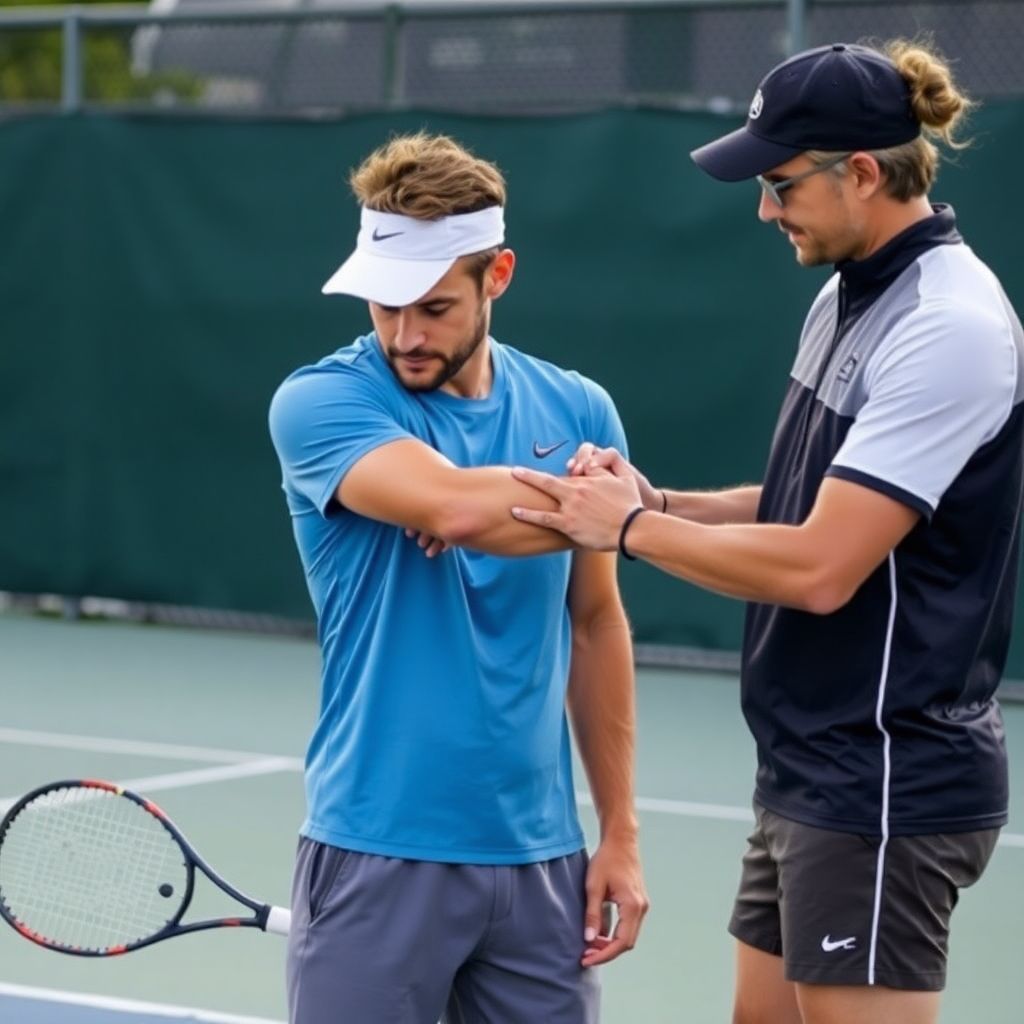
To protect your elbow and wrist in long tennis matches, simplify your swings, control pace, and plan active recovery between points. Use softer equipment, adjust grip and spin, and shorten rallies when fatigue or pain appears. If pain becomes sharp, localized, or alters your stroke, stop and seek professional assessment.
Core tactical principles to protect elbow and wrist
- Prioritise control and placement over raw power, especially on serves and returns.
- Use equipment and supports that soften impact and improve prevención lesiones codo y muñeca tenis.
- Shorten rallies when fatigue rises to avoid breaking down technique.
- Choose stroke patterns that keep the wrist firm and the elbow close to the body.
- Build between-point micro-routines to relax, stretch and reset grip pressure.
- Use simple If-then rules to change tactics at the first warning signs of overload.
Pre-match setup: gear, warm-up and inspection checklist
This approach suits most intermediate players who want mejores técnicas de juego para cuidar articulaciones en tenis during league matches and social play. Do not rely on these tactics if you have acute injury, visible swelling, or recent surgery; in those cases, stop and consult a sports physician or physiotherapist before competing.
| Item | What to check | Safe guideline |
|---|---|---|
| Racquet | Weight, balance, grip size | Moderate weight, slightly head-light, grip that you do not need to squeeze hard. |
| Strings | Type and tension | Softer strings (multifilament or gut) at medium-low tension to reduce shock. |
| Overgrip | Condition and tackiness | No slipping when lightly held; replace worn or smooth overgrips. |
| Supports | Braces/taping for elbow and wrist | Use only if comfortable, not too tight, and previously tested in practice. |
| Warm-up | Duration and structure | Progressive whole-body warm-up before any hard serving or heavy topspin. |
Pre-match preparation checklist on court
- Arrive early enough to complete a full-body warm-up, not just a few groundstrokes.
- Test serves and returns at 50-70% power before hitting full pace.
- Scan for any pre-existing discomfort in elbow or wrist during the first 5-10 minutes.
- Agree with your opponent on a decent warm-up instead of rushing to play.
- Clarify your tactical plan for cómo evitar dolor de codo y muñeca al jugar tenis: simple patterns, no hero shots early.
Warm-up sequence that prioritises elbow and wrist safety

- General activation (5-10 minutes) – Walk or lightly jog, add side-steps and dynamic leg movements. The goal is to increase body temperature gently.
- Specific joint mobility – Perform gentle circles for shoulders, elbows, and wrists. Avoid fast or forced movements; stay within a pain-free range.
- Elastic band work (if available) – Use a light band for external rotations, rows, and gentle wrist flexion/extension. Stop if you feel any sharp or unfamiliar pain.
- Progressive hitting – Start in the service boxes, then move back. Keep swings compact, no full-speed serves until you feel loose and coordinated.
- Test «match-like» points at 70% – Play 4-6 points at reduced intensity, focusing on smooth technique and breathing rather than winning.
Shot selection and technique tweaks to reduce joint load
Safer shot selection depends on having the right equipamiento y soportes para proteger codo y muñeca en tenis and a clear idea of which patterns stress your arm. You will need a properly matched racquet, suitable strings, and at least basic technical coaching to understand and apply the adjustments below.
| Situation | Higher-risk choice | Joint-friendly alternative |
|---|---|---|
| Baseline rally | Late, wristy forehands with heavy spin | Earlier contact, more body rotation, medium topspin with firm wrist. |
| Backhand | One-handed backhand under pressure | Use more two-handed backhands, slices, or high lobs when rushed. |
| Serve | Flat first serves at maximum power | Kick or slice serves at controlled pace, focus on rhythm and leg drive. |
| Return of serve | Full swings on big first serves | Block returns and chip shots with compact swings and early preparation. |
| Finishing point | Hard cross-court winners from off-balance | High, deep neutral balls or approach shots to the open court. |
Practical technique adjustments by stroke
- Forehand – Keep the wrist firm, avoid «slapping» the ball. Use legs and trunk rotation for power rather than overusing the arm.
- Backhand – For two-handed backhands, let the non-dominant hand drive the shot. For slices, keep the motion smooth, avoid cutting too steeply under the ball.
- Serve – Emphasise a fluid service motion with a consistent toss. Start matches serving at 70-80% power and only increase if your arm feels stable.
- Volleys – Shorten the backswing, use the body moving through the ball instead of punching with the wrist or elbow.
- Defensive shots – When stretched wide, prioritise high, deep balls or lobs over last-second wrist flicks.
If-then rules for safer shot choices
- If you notice growing tension in your wrist on heavy topspin forehands, then flatten the trajectory slightly and reduce racquet head speed.
- If your elbow hurts after one-handed backhands, then switch to more two-handed backhands and slices from neutral positions.
- If your first serve is painful, then immediately drop power, add more spin, or turn it into a safe «second serve» pattern.
Pacing the match: when to shorten rallies and when to push
Match pacing is central to consejos для reducir lesiones en partidos largos de tenis. Before you apply any pacing strategy, make sure your basic technique is pain-free in practice and that you can play short sets without symptoms. Never hide or push through sharp or sudden elbow or wrist pain simply to finish a match.
| Pre-pacing checklist | Yes/No |
|---|---|
| I can rally 10-15 balls in practice without elbow or wrist pain. | |
| I know at least one safe pattern to shorten points (serve + 1, approach, or high deep ball). | |
| I can recognise early signs of fatigue: slower footwork, late contact, loss of spin control. | |
| I am willing to sacrifice some power to protect my joints. |
Mini checklist before adjusting match tempo
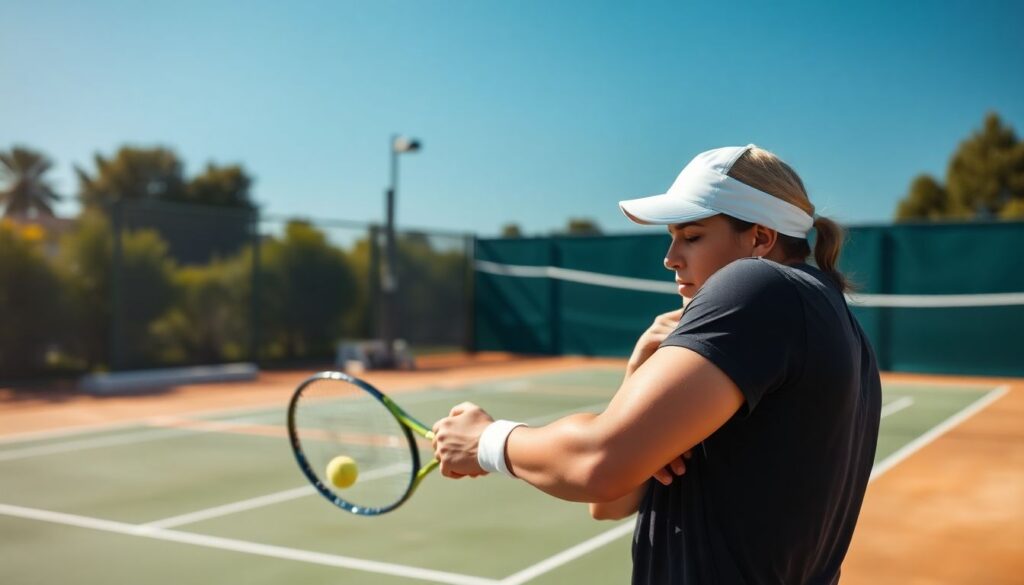
- Rate your current elbow and wrist comfort from 0 (no discomfort) to 10 (intense pain); do not exceed 3-4.
- Notice your breathing: if you cannot speak in full sentences at changeovers, you are overpacing.
- Identify which pattern currently costs the most effort: long cross-court rallies, repeated big serves, or chasing drop shots.
- Commit to one change for the next two games only, then reassess.
- Scan physical status every 2-3 games – Assess fatigue in legs and arm, quality of contact, and any emerging discomfort. If you feel your technique deteriorating, prepare to shorten points.
- Use controlled starts to each set – Begin sets with medium-intensity rallies and safer serves. This preserves joint health and lets you read the opponent before pushing the pace.
- Shorten rallies when form drops – Aim for patterns like serve plus one controlled aggressive shot, or early approaches to the net instead of trading long baseline exchanges.
- Extend rallies only when stable – If you feel fresh and your elbow and wrist are comfortable, you can test longer exchanges to tire the opponent, but keep strokes technically clean.
- Insert «recovery games» deliberately – After a very long or intense game, play a more conservative game with higher, deeper balls to give your body an active rest.
- Manage tiebreaks intelligently – In high-stress moments, avoid overhitting. Focus on first-serve percentage and safe targets to limit sudden, forceful strokes.
If-then pacing rules you can apply in real time
- If your elbow or wrist pain rises by more than two points on your internal scale, then shorten rallies for the next 3-4 games and reduce serve power.
- If your opponent starts to tire before you, then maintain a moderate rally length but keep your shots technically simple, not more explosive.
- If both of you are very fatigued, then prioritise safe placement and depth instead of sudden changes of direction and high-risk winners.
Court positioning and movement patterns that spare the arm
Good positioning lets your body, not your arm, absorb the workload. Focus on movement efficiency and anticipation so you hit more balls in a balanced stance, reducing the need for desperate, wristy saves that overload the joints over a long match.
| Positioning element | Risky habit | Joint-friendly habit |
|---|---|---|
| Default position | Standing too far back, reacting late | One step inside baseline when neutral, ready to move forward or back. |
| Side movement | Reaching with the arm instead of moving feet | Small adjustment steps so the ball enters your strike zone comfortably. |
| Net play | Charging blindly, ending in awkward volleys | Approach behind strong, deep shots; stop in a balanced volley stance. |
| Recovery steps | Admiring shots and staying in corners | Immediate recovery toward the centre after each stroke. |
Checklist to verify joint-friendly positioning and movement
- After most shots, you take at least one recovery step back toward a neutral position.
- You arrive to the ball early enough to set the feet before swinging, especially on the backhand side.
- You feel effort mainly in legs and trunk, not in isolated wrist or elbow movements.
- You rarely hit at full stretch with the arm fully straight and the wrist bent.
- You move around high balls instead of forcing low-contact, wristy strokes above shoulder height.
- Your approaches to the net come from strong, deep, or angled balls, not from defensive positions.
- On returns, you stand at a distance where you can use compact swings rather than last-second lunges.
- During long points, you maintain a consistent spacing from the ball instead of backing away and arming the shot.
- Your split-step is on time before the opponent hits, not after, allowing quicker, smoother first steps.
Between-points and set-time routines for acute relief
Smart micro-routines between points are a practical way to support prevención lesiones codo y muñeca tenis during long matches. They should be quick, discreet, and pain-free, helping to release tension without aggressively stretching or manipulating already irritated tissues.
| Moment | Helpful action | Unsafe action to avoid |
|---|---|---|
| Between points | Shake out arm gently, loosen grip, breathe slowly | Forceful stretching into pain or sudden jerks of the wrist. |
| Changeovers | Drink, small snack if needed, light forearm massage | Applying strong pressure on painful areas or using untested creams. |
| Set breaks | Gentle mobility, adjust game plan | Practising hard serves or heavy topspin during the break. |
Frequent mistakes in between-point management
- Ignoring early discomfort and waiting until pain forces you to change your game.
- Overstretching the forearm aggressively when tissues are already irritated.
- Keeping a death-grip on the racquet handle even when not hitting.
- Skipping hydration and light nutrition during long matches, leading to global fatigue and poor technique.
- Doing «test swings» at full speed between points instead of relaxing the arm.
- Applying new braces or taping mid-match that you have never tried in practice.
- Using painkillers during play to mask symptoms instead of respecting your body’s signals.
- Talking or complaining constantly instead of using the time to breathe, reset, and plan the next point.
- Rushing through changeovers and starting the next game without mental and physical reset.
When to change tactics mid-match: red flags and decision rules
In long matches, being willing to adjust your strategy is essential for cómo evitar dolor de codo y muñeca al jugar tenis. Have clear rules in advance so the decision feels automatic rather than emotional in the moment.
| Red flag | Tactical change | Reason |
|---|---|---|
| Sharp, pinpoint elbow or wrist pain on specific strokes | Stop hitting that stroke at full power, switch to safer variations or slice. | Reduces stress on the irritated structure while still keeping you in the match. |
| Loss of control on heavy spin shots | Reduce spin and speed, hit higher over the net with more margin. | Maintains safety and consistency when technique starts to break down. |
| Overall fatigue and slower footwork | Shorten points with smarter serves and early aggression on attackable balls. | Prevents reaching and arming the ball from poor positions. |
| Pain increasing despite previous adjustments | Retire from the match and seek professional evaluation. | Continuing may convert a mild overload into a significant injury. |
Alternative tactical profiles and when they fit
- Serve-and-first-strike style – Use when you can serve comfortably at moderate pace. Focus on placement and depth, then attack short returns. This reduces total swing volume while still being competitive.
- High-percentage baseliner – Use when your joints tolerate medium rally length but not explosive winners. Hit deep, cross-court with safe net clearance, rarely changing direction unless the court is clearly open.
- Net-oriented player – Use when volleys and overheads are comfortable and baseline grinding hurts. Build points to approach behind safe, deep shots; avoid sprinting in on defensive balls.
- Protect-and-finish later strategy – In league formats with multiple matches, accept playing at lower intensity today to protect your elbow and wrist for future matches.
If-then decision rules to end or modify play
- If pain forces you to consciously change your swing on most shots, then stop playing and seek assessment instead of improvising more compensations.
- If mild discomfort remains stable or improves with tactical changes, then you may finish the match but plan a rest period and technical review afterwards.
- If pain appears at night or the next morning after a match, then reduce future match volume and consult a professional about mejores técnicas de juego para cuidar articulaciones en tenis and equipment changes.
Concise answers on common tactical dilemmas and adaptations
How can I adjust my tactics in long matches to protect my elbow and wrist?
Use more controlled serves, earlier contact points, and patterns that shorten rallies without overhitting. Focus on depth and placement rather than power, and insert deliberate «recovery games» with higher, safer balls when you feel technique or joint comfort deteriorating.
What equipment changes help prevent elbow and wrist pain in tennis?
Choose a moderately weighted, slightly head-light racquet with a comfortable grip size and softer strings at moderate tension. Add overgrips for better tackiness and consider tested braces or taping as equipamiento y soportes para proteger codo y muñeca en tenis, always introduced first in practice, not competition.
Should I keep playing if my elbow starts hurting during a match?
If the pain is mild, diffuse, and improves after reducing power and shortening rallies, you may cautiously continue while monitoring symptoms. Stop immediately and seek professional help if the pain is sharp, localised, rapidly increasing, or forces major compensations in your technique.
Is it safer to play more at the net or from the baseline with elbow issues?
It depends on which strokes are comfortable. For many, controlled net play with compact volleys is easier on the elbow than long, heavy baseline rallies. Others feel better rallying at moderate intensity. Test both styles in practice to find the lower-stress profile for you.
How do I warm up specifically to protect elbow and wrist in tennis?
Start with general cardio, then gentle mobility for shoulders, elbows, and wrists, followed by light resistance work and progressive hitting. Avoid jumping straight into full-power serves or heavy topspin; build intensity gradually over several minutes of controlled strokes.
What in-match signs mean my tactics are too risky for my joints?
Red flags include more frequent mishits, needing to «muscle» the ball instead of swinging smoothly, new pain on specific strokes, and a general sense that the arm is doing all the work. Treat these as signals to reduce intensity and simplify patterns immediately.
Can tactical changes alone solve chronic elbow or wrist problems?
Tactics help reduce load and may prevent worsening, but they rarely fix chronic issues on their own. Combine tactical adjustments with technical coaching, strength and mobility work, and medical guidance when needed for a comprehensive prevención lesiones codo y muñeca tenis strategy.